

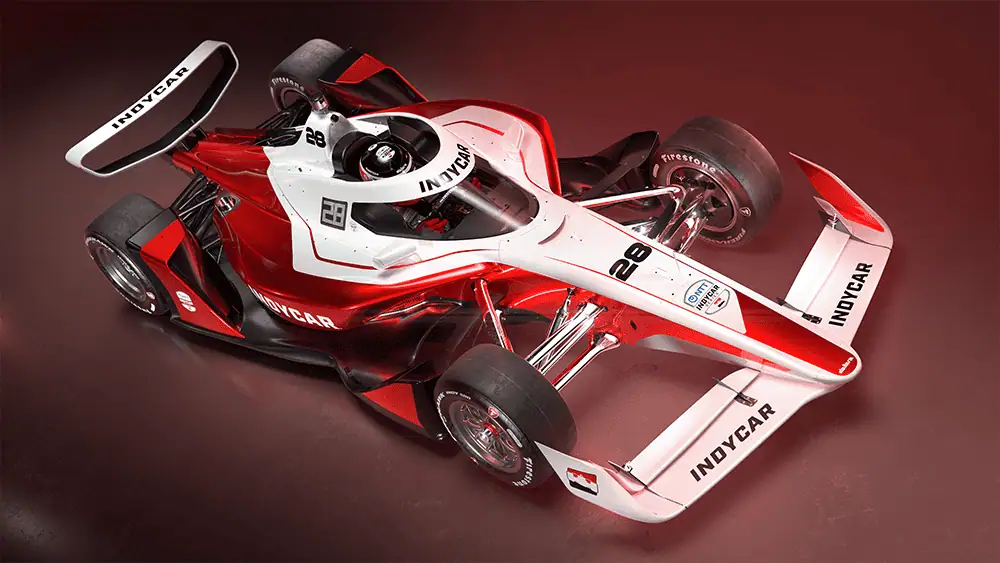
A new era of IndyCar racing is already taking shape.
The Dallara IR-28, the next-generation NTT INDYCAR SERIES race car, has moved from the unveiling stage into serious on-track development. After its first road-course validation at Indianapolis Motor Speedway in August, the car completed its first oval test at the same venue on September 9–10.
That matters.
The IR-28 isn’t scheduled to make its competition debut until the 2028 NTT INDYCAR SERIES season, but engineers are already collecting real-world data from different configurations, surfaces, temperatures, ride heights, and aerodynamic setups.
The IR-28 Is Built Around a Lighter Formula
Let’s be real: weight is a huge deal in racing.
INDYCAR says the new chassis is targeted to be around 100 pounds lighter than the current car. That reduction should improve the power-to-weight balance while helping the car respond more naturally on track.
The design also brings a more compact, modern appearance without abandoning the familiar IndyCar identity.
Dallara developed the chassis with a strong focus on airflow, weight distribution, driver protection, and closer racing. The bodywork around the front of the car has been designed to improve airflow management, potentially making it easier for following cars to remain competitive through corners.
A New 760-HP Hybrid Powertrain
Underneath the bodywork, the changes are just as significant.
The IR-28 will use 2.4-liter twin-turbocharged V6 engines from Chevrolet and Honda, with output of up to 760 horsepower. The new engine formula is designed to increase torque and power compared with the current generation.
The engine will work alongside an evolved low-voltage hybrid system.
That system brings greater energy-storage capacity and more flexibility in deployment while also reducing power-unit weight by roughly 20 pounds compared with the current setup. INDYCAR says the battery-based energy storage system will provide around 14 times the storage capacity of the existing hybrid system.
So this isn’t simply a styling exercise.
There’s serious mechanical change underneath.
Testing Has Moved From Road Course to Oval
The first IR-28 on-track validation took place at Indianapolis Motor Speedway’s 2.439-mile, 14-turn road course in August, with Alexander Rossi behind the wheel. That initial session marked the beginning of the car’s development program.
Then came the big oval test.
On September 9, Rossi drove the IR-28 in superspeedway configuration at the 2.5-mile Indianapolis Motor Speedway oval. Alex Palou took over the following day, giving INDYCAR and Dallara feedback from another driver and another set of environmental conditions.
The goal wasn’t to chase headline lap times.
Engineers were focused on understanding the car.
Ride height, aerodynamic balance, setup changes, and overall behavior were all part of the process. Palou completed his checklist early, while INDYCAR reported that the test produced valuable data for the next stage of development.
Aerodynamics Could Change the Racing Experience
One of the most interesting parts of the IR-28 is its aerodynamic philosophy.
The new car has been designed to manage its wake differently, with revised front and rear wings and a bodywork package intended to reduce some of the aerodynamic disadvantages suffered by following cars.
In plain English, the aim is simple: make it easier for drivers to race closely.
That’s particularly important in a series where tiny aerodynamic changes can have a major effect on balance and confidence at high speed.
Safety Remains Part of the Equation
Speed gets the headlines, but safety is central to the IR-28 project.
The new chassis includes a lighter integrated aeroscreen, improved cockpit dimensions, stronger side-impact structures, enhanced driver cooling, and crash-dynamics improvements intended to make the car more stable during sliding, spinning, and nose-up incidents.
The wider cockpit should also accommodate a broader range of driver sizes, another practical change that matters once the car moves from testing into full competition.
Plenty of Development Still Remains
The exciting part is that this isn’t the finished product.
INDYCAR and Dallara still have extensive testing ahead before the IR-28 reaches the full grid in 2028. Additional circuit types are important because a car that behaves well at Indianapolis must also handle road courses, street circuits, and high-downforce environments.
The September oval test was another piece of that larger puzzle.
And honestly, that’s what makes this development period interesting. We aren’t just seeing a new race car launch—we’re watching engineers, drivers, and manufacturers gradually discover what the machine can really do.
Final Thoughts
The IndyCar IR-28 race car represents a substantial shift for the series, combining a lighter Dallara chassis, revised aerodynamics, a 2.4-liter twin-turbo V6, hybrid technology, and new safety features.
Its 2028 debut may still be some distance away, but the testing program is already providing useful clues about the next generation of IndyCar racing.
For motorsport fans, the best part may be what’s still unknown.
Every test adds another piece to the picture.
